Crickets in the House in September: Which One You Have, and Why You Cannot Find It
The chirping starts in September and it always seems to come from inside a wall. You empty the garage looking for it, it stops the moment you get close, and it starts again the second you sit down.
Crickets come indoors at the same point every autumn, for the same reason everything else does — the nights get cold and the house does not. But which cricket you have changes what to do about it, and there are two very different ones.
Which one is in your house
The fastest test is whether it makes a sound.
House cricket. Straw-coloured to light brown, with three dark bands across the back of the head. Wings lying flat along the back, long antennae, and it runs rather than jumps. This is the one that chirps — only the males, and only to attract females.
Camel cricket. Also called a spider cricket or a cave cricket. Light to dark brown, half an inch to an inch and a half, and unmistakably humpbacked. No wings, enormous back legs, very long antennae. It cannot chirp at all — no sound-producing organs.
So: if you can hear it, it is a house cricket. If you keep finding silent hunched insects in the garage that leap at you when startled, that is a camel cricket, and the leaping is a defence reflex rather than aggression.

Where each one turns up
Camel crickets want damp and dark. Crawl spaces, basements, utility rooms, garages, under stored boxes, behind the water heater. If you are finding them, look at the humidity in that space before anything else.
House crickets want warm. They head for the kitchen, the laundry, near a furnace or boiler, and behind appliances that give off heat. Which is why the chirping seems to come from inside a wall — it often is, in the cavity near something warm.
Why the chirping is so hard to locate
Two reasons, and knowing them saves an evening.
The sound is a fairly pure tone, which human hearing is poor at placing directionally — unlike a click or a rustle, there is little for your ears to triangulate.
And the cricket stops when it detects vibration. Your footsteps announce you long before you arrive, so it goes quiet exactly when you get close and resumes when you retreat. The two facts together explain the whole frustrating experience.
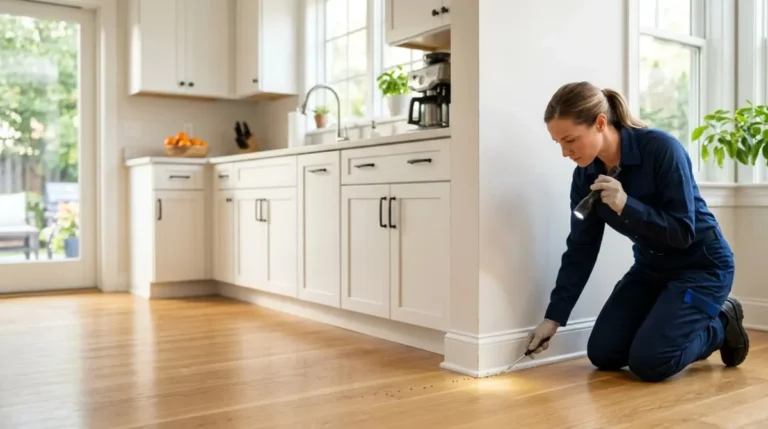
What works: stay completely still and let it start again, then move in one slow step at a time, pausing after each. Or wait until it chirps and have someone else stand at a different point in the room — two fixed positions place a sound far better than one moving one.
Why they are in the house at all
Crickets do not overwinter in your walls by choice. They are walking in at ground level because the outside has become uncomfortable and the gap under your door has not.
That matters because it makes them one of the easiest indoor pests to prevent. They are not flying to an upper storey or getting in through the roof. Almost everything comes through the bottom few inches of the building.
What actually keeps them out
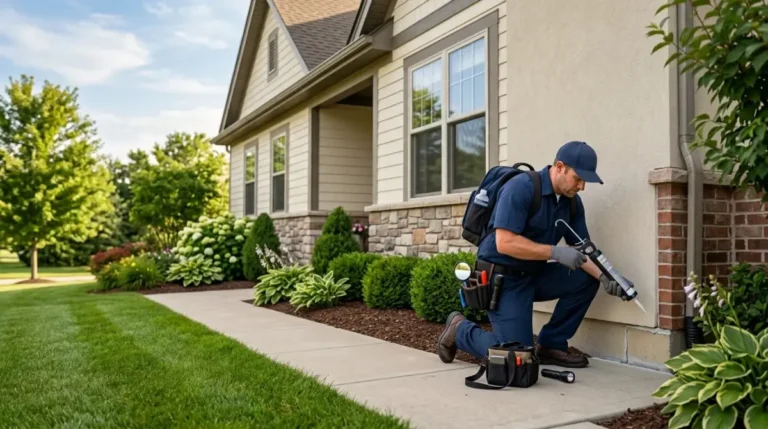
- Door sweeps. The garage side door and the door from garage to house are the two biggest routes in most homes. If daylight shows under a door, a cricket walks under it.
- The garage roller door seal. Perished rubber along the bottom is standard, and it is a continuous opening the width of the house.
- Weep holes and utility entries at ground level — screen rather than seal, so drainage and airflow still work.
- Move the harbourage off the wall. Firewood, stacked pavers, bagged mulch and leaf litter against the foundation are where they live before they come in. Twelve inches of clear ground does more than any spray.
- Dry the damp spaces if it is camel crickets. A dehumidifier in a crawl space or garage removes the reason they are there.
- Turn off or change outdoor lights. White porch and security lights draw insects to the wall all evening. Warm-toned or yellow bulbs pull in far fewer.
What they actually damage
Mostly they are a noise problem. But house crickets will feed on fabric — wool, cotton, silk, and anything with a food or perspiration stain on it. Clothes left in a laundry basket in a cricket-active garage or basement can genuinely be chewed.
They also feed on paper and cardboard, which is worth knowing if you store boxes in the garage.
When to bring someone in
One chirping cricket is a torch and a bit of patience. It is worth calling when you are finding them in numbers rather than singly, when they keep returning after you have sealed what you can reach, when it is camel crickets in a crawl space you cannot get into, or when the entry points are structural rather than a gap under a door.
Persistent numbers usually mean a moisture problem or a harbourage right against the building — and both of those are worth finding, because they are the reason for the next thing as well.
Our general pest control page covers what that involves.
The one thing to take away
Listen first. Chirping means a house cricket, somewhere warm. Silence and a hunched back means a camel cricket, somewhere damp. Those are two different problems with two different fixes — and both of them start at the bottom few inches of the building, not inside it.