Ladybugs All Over the House in September? Those Are Asian Lady Beetles
They arrive on a warm afternoon in September, and always on the same wall. A few dozen at first, then a few hundred, sitting on the sunny side of the house doing nothing in particular. By evening some of them are on the inside of the window.
Most people call them ladybugs and assume it is a nice problem to have. It is almost certainly not a ladybug.
How do you tell an Asian lady beetle from a ladybug?
Look at the white patch behind the head. An Asian lady beetle has a pale, almost white shield behind its head with a black M-shaped marking on it. Turn the beetle so the head is at the top and the M is obvious. A native ladybug has no M.
Three other tells:
Colour. Native ladybugs are a consistent bright red. Asian lady beetles range from red through orange to a pale tan, and a single cluster on one wall can contain all three.
Spots. Ladybugs always have black spots. Asian lady beetles may have nineteen, may have two, may have none at all.
Size. Asian lady beetles run slightly larger and look a little more domed.
But the behaviour is the real giveaway. Native ladybugs do not gather on the outside of your house in the hundreds. If it is happening, you have Asian lady beetles.
Why are they all on one side of the house?
Because they are choosing it deliberately, and their criteria are narrow: a sunny, light-coloured, south or south-west facing surface. That is why the beetles cover one wall and leave the shaded north side of the same building completely alone.
In their native range these beetles overwinter on pale, sun-warmed rock faces on the south side of mountains. A cream-rendered wall catching the afternoon sun reads to them exactly like that cliff. The house is not being invaded so much as mistaken for a mountain.
Once the first arrivals settle they release an aggregation pheromone that pulls the rest in, which is why the count goes from twenty to two thousand within a couple of days.
What sets the swarm off?
It is a pattern rather than a date. The trigger is a sharp cold snap followed by a warm, still, sunny afternoon — the cold tells them the season has turned, and the warm day gives them the flight conditions to move. Around 60°F is roughly where they start looking for shelter, and the mass flights happen on the mild days that follow the first cold nights.
This is why it feels so sudden. There is no build-up. One October afternoon the wall is clear and the next it is covered, and in between there was a cold night nobody paid attention to.

Why should you not squash them?
Two reasons, and both are worth knowing before you reach for a tissue.
They stain. When stressed, an Asian lady beetle bleeds a yellow fluid from its leg joints. It smells unpleasant and it marks curtains, painted walls, carpet and light-coloured upholstery, and those marks are difficult to lift.
The smell is a signal. Crushed beetles leave chemical residue that other beetles read, so a squashed cluster on a windowsill can make that spot more attractive rather than less.
The same goes for the wall outside. Once a building has been used, traces of the aggregation pheromone can persist and the same house gets chosen again the following autumn. Some homes get them every single year while the identical house four doors down never does.
Do Asian lady beetles bite?
They can pinch. They have chewing mouthparts and will occasionally nip exposed skin — it stings briefly, it does not draw blood, and it carries no disease. It is startling rather than harmful.
Are they a problem for dogs?
This is the part most people have never heard, and it is the one worth acting on. Dogs sometimes lick or chew clusters of these beetles, and the same defensive fluid that stains a windowsill can irritate a dog’s mouth. There is a published veterinary case of beetles becoming lodged against the roof of a dog’s mouth and causing chemical-burn-type damage.
It is uncommon, but if you have a dog that eats things off the floor, clear the clusters rather than leaving them. If your dog is drooling heavily, pawing at its mouth or off its food after a beetle swarm, that is a vet call, not a wait-and-see.
How do you get the ones already inside out?
Vacuum them, with one modification. Slide a knee-high nylon stocking down inside the vacuum extension hose, fold the open end back over the hose mouth and hold it with a rubber band. The beetles collect in the stocking instead of the machine. When you are done, pull the stocking out, tie it shut and put it in an outside bin.
Without the stocking you get beetles loose in the vacuum, the smell in the filter, and live ones crawling back out of the hose an hour later.
Do not spray insecticide inside for these. It kills beetles inside wall voids and attics that you cannot reach, and dead insects in a cavity become food for carpet beetles later in the winter. Physical removal is the correct answer indoors.
What actually stops it happening again?
Exclusion, and it has to be done before they arrive rather than after.
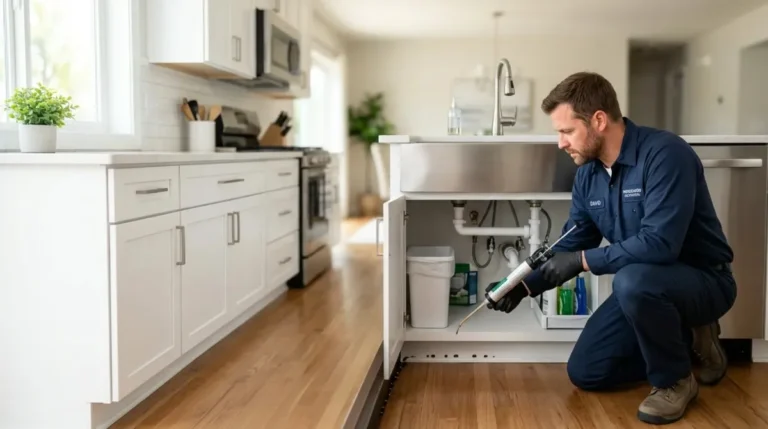
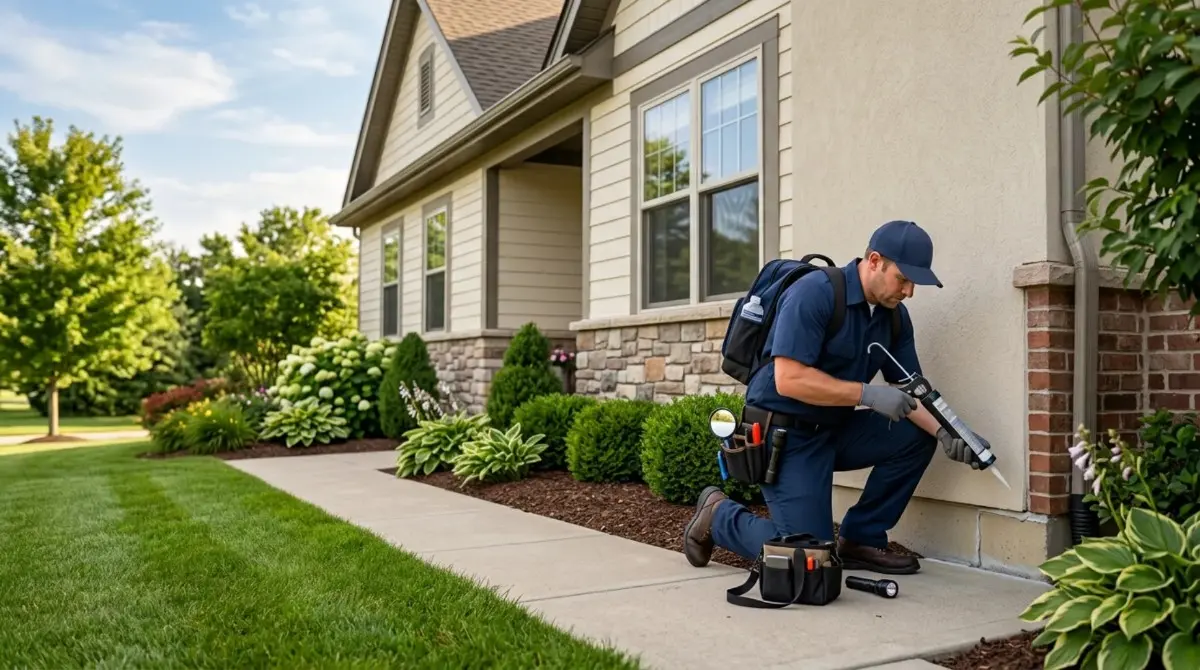
Seal anything an eighth of an inch or wider. That is the working number for this beetle — window and door frames, where siding meets trim, utility and cable penetrations, and gaps under lifted flashing.
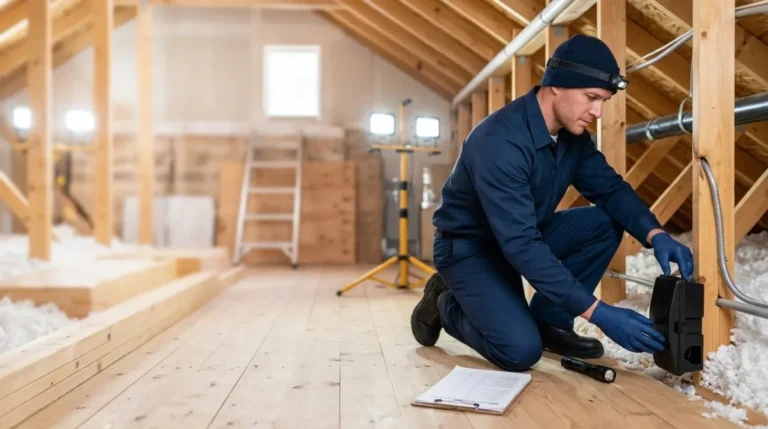
Deal with the ones nobody checks. Attic and soffit vents with torn screening, the gap above a garage door where the seal has compressed, and the top edge of window frames on the sunny wall.
Fix window screens on the warm side first. A screen with a small tear on the south-west wall will let in more beetles than every other opening in the house combined.
Timing matters more than thoroughness. Sealing done in late September keeps them out. The same work done in late October seals them in.
An exterior treatment on the sunny walls and around openings, applied before the first flight, is the other half of it — and that timing is the whole trick, because once the beetles are behind the siding there is very little any treatment can usefully do.
The short version
Black M behind the head, hundreds of them, all on the sunny wall — Asian lady beetle, not ladybug. Vacuum rather than squash, keep the dog away from the clusters, and get the gaps sealed while the weather is still mild. They are a nuisance rather than a danger, but they are a nuisance that returns to the same house every year until the building stops letting them in.
Not sure what you are looking at, or want the outside of the house treated before the first cold snap? General pest control covers these autumn beetles, and our guide to sealing the house against fall invaders walks through the same exclusion work for stink bugs and cluster flies.