
Fall Mouse Season: Why Mice Move In During September — and How They Get Through a Dime-Sized Gap
Sometime in the next few weeks — the exact date depends on where you live — night temperatures will slip below about 45°F, and every mouse within reach of your foundation will start looking for somewhere warmer. This is not a slow drift. Field research and pest control call logs agree: September and October are when mice move indoors, and the young mice born over the summer are now adults hunting for their own winter territory.
The house they pick is not random. It is the one with an opening.
How small a gap actually is
The number that surprises people: an adult mouse can get through a gap the size of a dime — about a quarter of an inch. If a pencil fits, a mouse fits. Their skeleton is built for it; the skull is the widest part, and if the head goes through, the rest follows.
That changes what “sealed up” means. People check the front door and the garage and call it done. A mouse is not using the front door. It is using:
- The gap under the garage door — the rubber seal wears into a curve at the corners, and that corner curve is a quarter inch
- Where pipes and cables enter the wall — the hole was drilled bigger than the pipe, and whatever filled the ring has dried and cracked
- Dryer and range vents with a broken or missing flap
- Weep holes in brick — they must stay open for drainage, but they can be screened
- The roofline — where fascia meets shingle, and around anything that penetrates the roof. Mice climb brick and stucco without difficulty
- Foundation cracks hidden behind shrubs and mulch
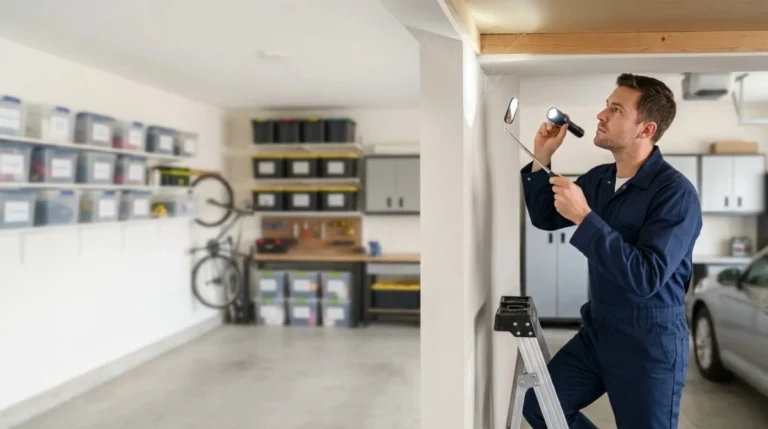
The useful habit: once a year, in early September, walk the entire outside of the house at knee height with a flashlight, slowly. You are looking for anything you could slide a pencil into.
The first signs — usually in this order
Sounds at night. Soft scratching or scurrying inside a wall or ceiling, almost always after dark, and most often near the kitchen, garage or laundry. Mice are nocturnal; if you are hearing daytime activity, the population is bigger than you think.
Droppings. Dark grains the size and shape of rice, pointed at the ends. A single mouse leaves 50 to 80 of them a night, concentrated along walls, inside cupboards, under the sink and behind appliances. Fresh droppings are dark and soft-looking; old ones are dry and faded — which tells you whether the activity is current.
Gnaw marks. Fresh, pale tooth marks on the corners of boxes, the edges of door frames, and around any hole they are widening. A small pile of shavings or crumbs beside the mark means it is recent.
Grease smears. Mice run the same routes every night, hugging the wall, and the oil in their fur gradually leaves a grey-brown smudge along the baseboard and around the entry hole. A rubbed, dirty ring around a small opening is as close to a signed confession as you will get.
A nest. Shredded paper, insulation or fabric packed into a dark corner — behind the fridge, in a stored box, in the back of a rarely opened cabinet, in attic insulation. A clean, dust-free tunnel through an otherwise dusty space is the giveaway.
Why one mouse is never one mouse
A female house mouse can produce a litter of five or six pups roughly every three weeks through the winter, and those pups breed at six weeks old. The pair that slipped in behind the dishwasher in late September is a colony by January. This is the entire argument for acting in the first week rather than the sixth — the difference is not two mice, it is dozens.
There is a health dimension too. Mice contaminate far more food than they eat — those 50 to 80 nightly droppings end up in drawers, on counters, and in the back of the pantry — and dried rodent waste can carry pathogens including hantavirus, which is why vacuuming dry droppings is the wrong move. Damp-wipe with disinfectant instead, wearing gloves.
What actually keeps them out
Steel wool plus caulk for small gaps — mice can pull out loose steel wool, so it needs the caulk to hold it. For anything bigger, hardware cloth or sheet metal. Expanding foam alone does not work; mice chew through it in a night.
A new garage door seal if the corners have worn into a curve. This is one of the highest-value fixes on the list.
Trim vegetation back from the walls. Branches touching the roofline are a bridge, and shrubs against the foundation hide the very gaps you need to find.
Move the food. Bird seed, pet food and grass seed stored in the garage in their original bags are the single most common thing pulling mice toward a house. Steel or thick plastic bins with tight lids.
Firewood off the ground and away from the wall. A wood pile against the house is shelter, and shelter ten feet from a warm foundation is an invitation.
Quick answers
I heard scratching but there are no droppings — could it still be mice? Yes, early on. Check the darkest, least disturbed places first: behind the kitchen kick plates, under the sink, the back of the pantry, around the water heater. If the sounds continue and you find nothing, the activity may be in the attic or wall voids.
Do sonic repellers work? The evidence is weak. Mice habituate to the sound within days. Exclusion — physically closing the openings — is what works.
Will they leave on their own in spring? Some do. Many do not, because a house offers food and safety year-round. And by spring, the pair from October has multiplied.
Traps or professional help? A single mouse caught early is a fair DIY job. Repeated catches, noise in more than one room, droppings in the attic, or a smell you cannot place means the population is established — and the real work at that point is finding and sealing every entry, not just removing the mice you can see.
If the scratching has already started
Our rodent control page covers what professional treatment involves — inspection, exclusion and removal, not just traps. To check coverage where you live, start at the locations directory. Fall rodent pressure runs heaviest in the colder half of the country — cities like Chicago, Minneapolis and Denver see the September rush first, but no state sits it out entirely.