
How to Check Your Mattress for Bed Bugs — And What It Means If You Find Nothing
Nobody reads this article casually. You are here because you woke up with marks on your arm, or you saw something small and dark move across the sheet, or you got back from a trip and now you cannot stop thinking about the suitcase sitting in the corner of the bedroom.
So let us skip the reassurance and do the actual inspection. It takes about twenty minutes, it costs nothing, and by the end you will know considerably more than you do right now.
What you need
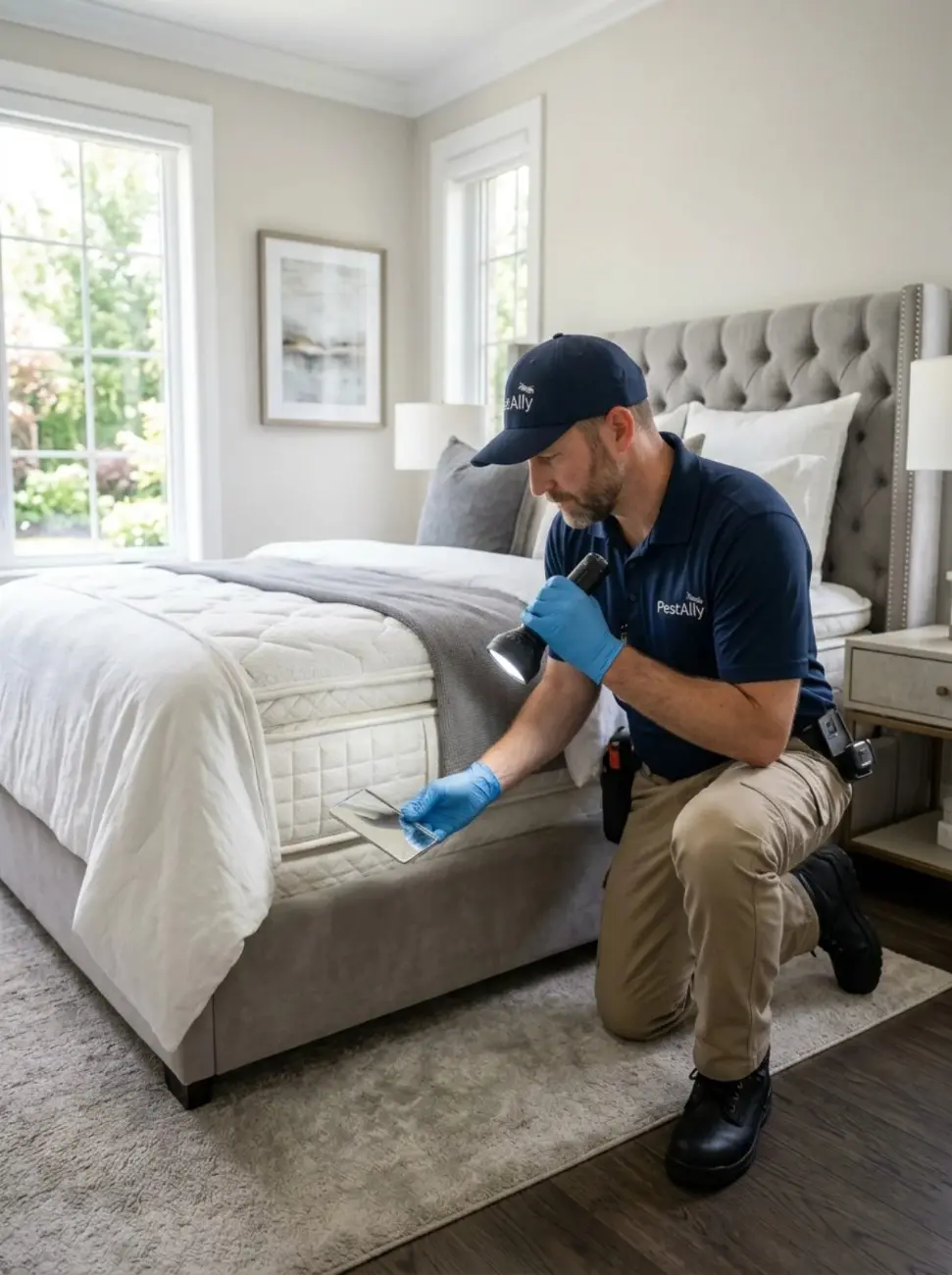
A flashlight — the one on your phone works, though a real torch is better because you can hold it at a low angle. An old credit card or gift card for dragging along seams. A white paper towel or plain white cloth. And your phone camera, because bed bug evidence is small, and photographing it lets you zoom in on something your eyes cannot quite resolve.
Strip the bed completely first. Sheets, mattress protector, pillowcases — everything off, straight into a bag rather than onto the floor, and into a hot dryer afterwards.
Where to actually look, in order
Start with the seams and piping, not the surface. Bed bugs do not sit out in the open on a mattress top. They wedge themselves into the folded edge — the piping that runs around the perimeter, the seams, and underneath the fabric tags. Run the edge of the card along the piping and watch what comes out.
Then do the box spring, and give it more time than you gave the mattress. This is where most home inspections go wrong. People check the mattress thoroughly, find nothing, and stop. But a box spring is a wooden frame with a thin fabric dust cover stapled underneath, and that dark hollow interior is far better harbourage than a mattress ever offers. Tip it on its side and look at the underside. If the dust cover has any tear or loose corner, shine the light inside it.
Then the bed frame. Joints, screw holes, the underside of slats, and every place two pieces of wood meet. Wooden headboards with decorative grooves are a particular favourite.
Then behind the headboard. Lift it off the wall if you can. Check the wall itself, the outlet plate nearby, and any picture frame hanging above the bed.
Then the nightstand. Pull the drawers all the way out and turn them over — the underside of a drawer is a classic hiding spot that almost nobody thinks to check.
The four things you are looking for
They appear roughly in this order as an infestation develops, which matters — because the earliest evidence is the least dramatic.
Dark spots. Small dots, roughly the size of a full stop, dark brown or black. This is digested blood. The identifying test is that it bleeds into fabric like a marker pen rather than sitting on top of it like a crumb of dirt. Touch a damp white paper towel to one — if it smears out into a rusty brown halo, that is what you think it is.
Rusty or reddish smears on the sheet or mattress, which is what a bed bug looks like after somebody rolled over on it during the night.
Shed skins. Translucent, hollow, bug-shaped. Nymphs moult five times as they grow, so shed skins are not merely a sign that bed bugs are present — they are a sign that bed bugs are breeding and maturing there. Look along seams and in the corners of furniture.
Eggs and live bugs. Eggs are about 1 mm, pale and pearl-like, usually cemented into a crevice in small clusters. Adults are the size and colour of an apple seed — reddish brown, flat, oval. Young ones are much paler, almost translucent, and genuinely hard to see against a light mattress.
A heavy infestation also carries a musty, sweetish smell from the bugs’ scent glands. If you can smell it, you are well past the early stage.
You checked everything and found nothing. Now what?
This is the part most articles skip, and it is the situation most people are actually in.
Finding nothing is genuinely good news. It is not proof.
Three things are true at once, and they pull in different directions:
Bed bugs are not confined to the bed. They hide in cracks in furniture, floors and walls. A light, early infestation can live in a skirting board seam three feet away and leave almost nothing on the mattress at all.
People react to bites very differently. The reaction is an immune response — some people develop welts within hours, some not for several days, and some never react visibly at all. Two people can share a bed and only one of them shows anything.
Most people cannot identify a bed bug. In one survey, only 29% of Americans could. That cuts both ways: people miss real bed bugs, and people also convince themselves that a harmless insect is one.
So no evidence found does not rule bed bugs out — and bites alone do not rule them in.
The thing it very often turns out to be instead
Carpet beetles. This mix-up is common enough that it deserves its own section.
Carpet beetle larvae do not bite anyone. But they are covered in tiny barbed hairs, and in sensitive people those hairs trigger an allergic skin reaction that produces red, itchy welts looking convincingly like bites.
Here is how to separate them:
- Bed bug bites tend to appear on exposed skin — arms, shoulders, neck, whatever was outside the covers — often in a line or a tight cluster.
- Carpet beetle reactions tend to appear under clothing, wherever fabric held the larval hairs against your skin, and they are scattered rather than patterned.
- Bed bugs leave feeding evidence: the dark spots, the smears, the shed skins. Carpet beetles leave none of that.
- Carpet beetles leave different evidence: new small holes in wool blankets, jumpers, or anything made of natural fibre.
Patterned marks plus blood spotting points one way. Random irritation with no feeding signs, and holes in the wool jumper, points the other.
Three things not to do while you work it out
Do not set off a fogger or bug bomb. They do not penetrate the cracks where bed bugs actually live, and the repellent effect drives survivors deeper into walls and adjacent rooms. A treatable problem in one bedroom becomes a problem across the whole floor.
Do not throw the mattress out yet. It is expensive, it usually does not solve anything because the population is rarely confined to the mattress, and dragging an infested mattress through the house is an efficient way to seed the rest of it.
Do not start sleeping in the spare room or on the sofa. This is the single most common well-intentioned mistake. Bed bugs follow the carbon dioxide you exhale. Move, and you simply take the problem with you into a second room.
What to do instead
Put encasements on the mattress and box spring — zip covers made for this purpose. Anything already sealed inside is trapped and starves; anything new has nowhere to hide and shows up on the smooth outer surface where you can see it.
Put interceptor cups under each bed leg. They are inexpensive plastic dishes that bugs fall into and cannot climb out of. Leave them two weeks, then check. This turns guesswork into passive monitoring that runs while you sleep.
And if you are still uncertain after that, get a professional inspection. Trained inspectors — and in many cases scent-detection dogs — find light infestations that a homeowner with a torch simply will not.
Quick answers
Can I see bed bugs with the naked eye? Adults yes, easily — apple-seed sized. Nymphs and eggs are much harder, and eggs at 1 mm sit close to the limit of what most people can pick out on a patterned mattress.
How fast does an infestation grow? A female lays roughly one to three eggs a day, continuously. That is why the gap between “I think I saw one” and “this is everywhere” feels so much shorter than people expect.
Does a clean house prevent them? No. Bed bugs feed on blood, not crumbs. Clutter gives them more places to hide, which makes treatment harder — but cleanliness has nothing to do with whether they arrive in the first place.
They came from a hotel, didn’t they? Often, yes — luggage is the classic route. But used furniture, a visitor’s bag, and shared laundry facilities all do the same job.
If it turns out you do have them
Bed bugs are one of the few pests where the DIY-versus-professional question has a clear answer. They hide in places you cannot reach, they survive months without feeding, and a treatment that kills 95% of them leaves you back where you started within a few months.
Our bed bug treatment page explains what professional treatment actually involves and how long it takes. If you want to know whether we cover your area, start at the locations directory — bed bug calls run heaviest in dense rental markets like New York City, Houston and Orlando, where turnover between tenants and a steady flow of visitors keep moving them between buildings.