
Why Yellow Jackets Turn Aggressive in Late August — And What to Do About a Ground Nest
Something changes in late August. The same yellow jackets that ignored you all summer while you ate lunch on the deck are now landing on the rim of your glass, hovering over the grill, and going after anyone who waves at them. It feels personal. It is not — but it is real, and it is predictable enough to plan around.
Here is what is actually happening inside the nest, and why the next six weeks are the worst of the year for stings.
The colony changed jobs
For most of the summer, a yellow jacket colony runs on a simple arrangement. Workers hunt insects and protein to feed the larvae. In return, the larvae secrete a sugary liquid that the adult workers feed on. It is a closed loop, and it keeps the workers busy, fed, and largely uninterested in you.
In late summer the queen stops producing workers and switches to raising next year’s queens and males. Once those fertile siblings leave, the loop breaks:
- Fewer larvae means less of that sugary secretion. The adults lose their food supply and start hunting sugar somewhere else — your soda, your fruit, your bin.
- Nobody left to feed. Workers no longer spend the day hunting protein for young. They forage for themselves.
- The colony is at maximum size. A nest that started in spring with a handful of workers can now hold hundreds or several thousand. More insects, and far more of them available to respond when something disturbs the nest.
- Natural food is running out. The whole colony is under nutritional stress, which makes foragers defensive and quicker to sting without much provocation.
Put together: more yellow jackets, hungrier, with nothing to do but defend themselves and find sugar. That is why August and September produce the most stings of the year.
Which one is actually bothering you
People use “wasp” for everything with a stinger. The difference matters here, because it changes how much caution the situation deserves.
Yellow jackets are about half an inch long, bright yellow and black, with smooth bodies and a compact shape. They fly quickly and directly, with legs tucked in.
Paper wasps are longer and slimmer, brown with yellow or orange markings, and they dangle their legs while flying — once you have noticed that, you cannot unsee it. They build the open, umbrella-shaped combs you find under eaves.
The behavioural difference is the important part. Paper wasps rarely sting unless you actually bump the nest or grab one, and when they do it is usually one or two insects. Yellow jackets attack as a group and each one can sting repeatedly. They are responsible for most wasp stings and most sting allergy reactions in the United States.
The nest you cannot see
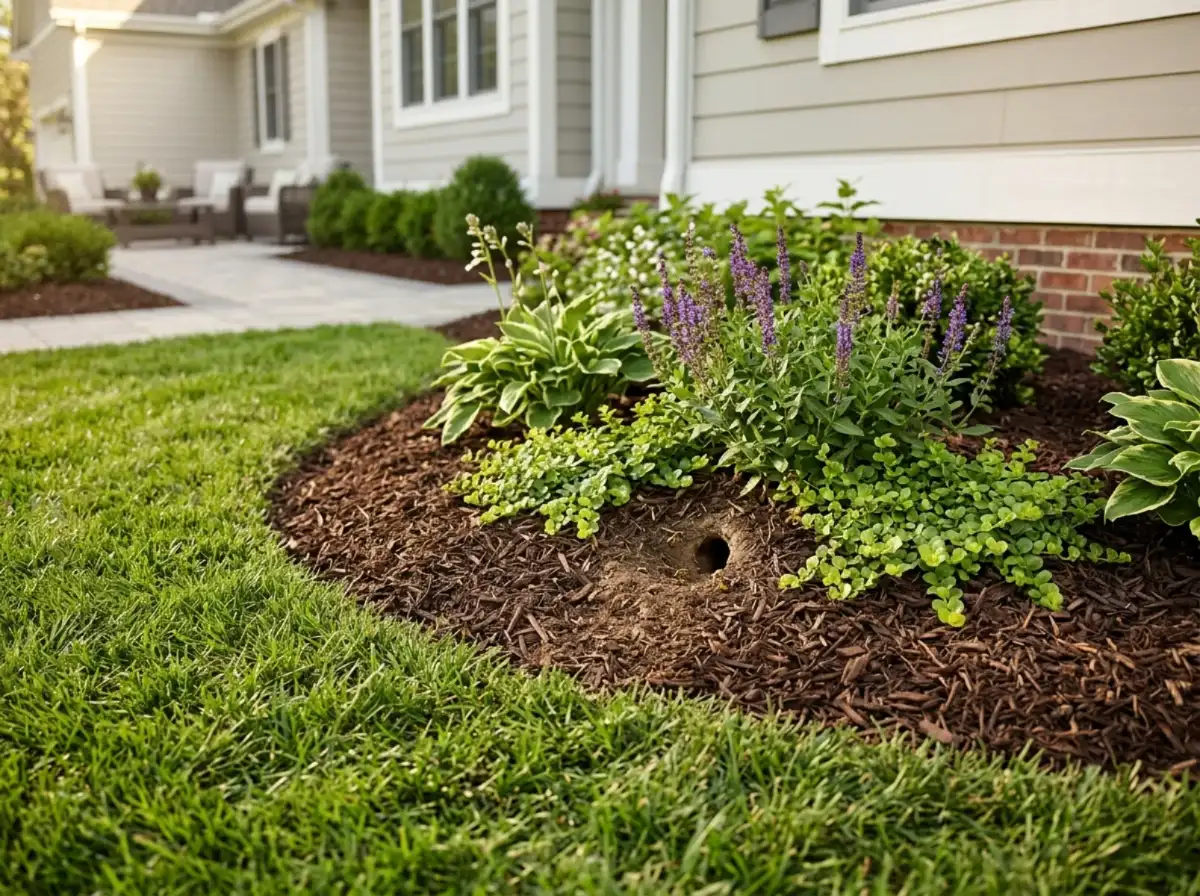
Yellow jackets often nest underground, and they rarely dig their own hole. They move into an abandoned burrow left by a mole, a chipmunk, a squirrel or a rat, then build downward inside it.
This is the dangerous version, for one reason: there is nothing to see. No grey paper football hanging in a tree, no comb under the eaves. Just a hole in the lawn, sometimes no wider than a coin, with insects going in and out. If you are not looking for it, you will not find it.
Which is how the classic late-summer injury happens. Somebody runs a lawnmower over the entrance, or catches the edge of it with a string trimmer, or steps on it while pulling weeds. The vibration reaches the nest, and hundreds of defenders come out at once — into a person who has no idea a nest was there and no route out of the way.
How to find one before it finds you: pick a warm, sunny afternoon and stand well back from the area you are worried about. Watch the ground for two or three minutes. A nest gives itself away as steady two-way traffic — insects arriving and leaving on the same flight line, into the same spot. That repeated line is the tell. One wasp wandering across the lawn means nothing.
If you find one, mark the area from a safe distance — a stake, a cone, a chair — and keep children and pets away from it.
Four things that make it worse
Do not pour gasoline, petrol or any fuel into the hole. It is an old piece of advice and it is dangerous nonsense. It poisons your soil and groundwater, it is a serious fire risk, and it very often fails to reach the whole nest — leaving you with a surviving, thoroughly enraged colony.
Do not pour boiling water in. Same problem: underground nests extend further than the entrance suggests, and water cools as it travels. You will scald the entrance chamber and infuriate everything below it.
Do not block the entrance. Yellow jackets do not simply give up and die. They dig out — often through a new exit, and sometimes that new exit is inside a wall cavity if the nest was against your foundation.
Do not stand over the hole with a can of spray. Aerosol wasp killers are designed for aerial nests you can hit from a distance. Standing directly above a ground nest entrance puts you at the exact point where every defender emerges, and this is peak season for colony size.
Keeping them off the patio
You cannot negotiate with a colony’s hunger, but you can stop advertising.
Yellow jackets in September want sugar first, protein second. That means open drinks, fruit, juice spills, sticky bin lids, fallen apples and pears under a tree, and the sweet residue in a recycling bin nobody rinsed.
- Drink from cans with a lid or a straw outdoors. A yellow jacket inside an open can is how people get stung in the mouth and throat — the one sting location that is an emergency regardless of allergy.
- Keep bin lids properly closed and rinse anything sugary before it goes in.
- Pick up windfall fruit. A tree dropping ripe fruit is a permanent buffet.
- Wipe the grill and the table straight after eating rather than at the end of the evening.
- Move the bins away from the door and the seating area if you can.
One thing worth knowing: swatting makes it worse. A crushed yellow jacket releases an alarm signal that recruits others. Stay still, or walk away calmly. Flailing is what turns one insect into several.
When a sting is a medical emergency
Most stings hurt badly, swell, and resolve. Some do not. Get emergency help immediately for:
- Difficulty breathing, wheezing, or a tight throat
- Swelling of the face, lips or tongue
- Dizziness, fainting or a racing pulse
- Widespread hives away from the sting site
- Any sting inside the mouth or throat
- Multiple stings — a group attack delivers a far larger venom dose than a single sting, and that matters even in people with no allergy
Roughly 0.5 to 4% of people have a genuine venom sensitivity. Because yellow jackets attack in numbers, the risk of a serious dose is much higher with them than with a paper wasp.
Quick answers
Will they die off in winter anyway? Yes. The first hard frosts kill the colony, and only new queens survive to overwinter elsewhere. But that is October or November in much of the country — you have the worst weeks of the season to get through first, and a nest by a doorway or a play area is not something to simply wait out.
Will they reuse the nest next year? No. Yellow jackets do not reoccupy an old nest. But a site that suited them once — the same burrow, the same wall void, the same sheltered corner — will often attract a new queen next spring.
Can I just wait until dark? Yellow jackets are less active at night, which is why treatment is usually done then. It does not make a peak-season ground nest safe to approach without protective equipment, and a torch beam gives them something to fly toward.
Why are there suddenly so many? The colony has been growing quietly since spring. You are not seeing new arrivals — you are seeing a nest that has reached full size at the same moment its workers ran out of food at home.
When to bring in help
An aerial nest in an open spot, caught early and treated carefully, is sometimes a homeowner job. A ground nest in late August is a different proposition: hidden extent, a colony at maximum strength, hundreds of defenders, and no way to retreat once you have disturbed it.
It is worth calling a professional when the nest is in the ground, inside a wall or roof void, near a doorway, path or play area, or when anyone in the household has a known sting allergy.
Our yellow jacket control page covers how professional treatment works and what to expect, and the wasp control page covers paper wasp and hornet nests if that turns out to be what you have. To check coverage in your area, start at the locations directory — calls climb sharply from late August across the Midwest and Northeast, including cities like Pittsburgh.