
Paper Wasp, Yellow Jacket or Bald-Faced Hornet? How to Tell Before You Get Close
Almost every stinging insect that lands on a picnic table gets called a wasp, and almost every grey papery nest gets called a hornet nest. The names get used interchangeably — but the three insects behind them build in different places, behave differently when you get close, and need to be handled differently.
Getting the identification right in the first thirty seconds is what keeps this from turning into a bad afternoon.
Tell them apart by the nest, not the insect
The insect moves and you are usually not keen to get close. The nest stays put, and it is the more reliable clue.
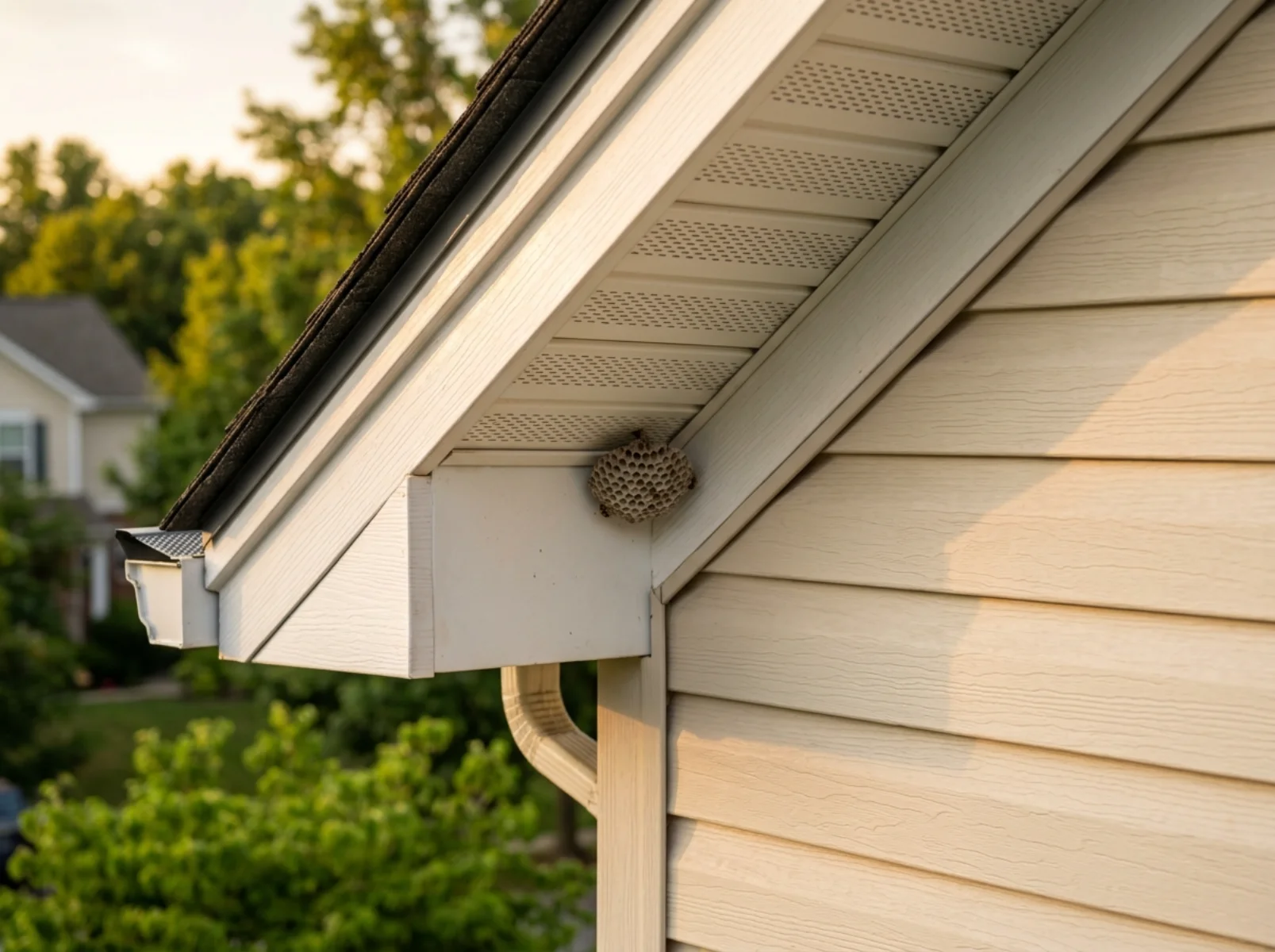
- An open umbrella shape hanging from a short stalk — under an eave, a porch ceiling, a window frame, inside a shed. You can see the individual six-sided cells because there is no outer covering. That is a paper wasp.
- A hole in the ground, or nothing visible at all — insects streaming in and out of a gap in the lawn, a gap in the siding, or a wall void. That is a yellow jacket, and the nest can hold up to a thousand workers by this point in the year.
- A grey papery football hanging from a branch or eave, fully enclosed with one small opening near the bottom. That is a bald-faced hornet.
And by the insect, if you get a clear look
- Paper wasp — ¾ to 1 inch, slender, narrow-waisted, smoky wings folded lengthwise at rest. The giveaway is in flight: long thin legs dangling underneath. Nothing else does that.
- Yellow jacket — the smallest at around ½ inch, bright yellow and black, and compact rather than slender. This is the one at your drink.
- Bald-faced hornet — up to ¾ inch, black with ivory-white markings on the face and the tip of the abdomen. No yellow anywhere, which is the fastest way to separate it from a yellow jacket.
Which one is actually dangerous to you
They are not equally risky, and the ranking surprises people.
Paper wasps are the least aggressive of the three. They will defend the nest if you get close, but they are not looking for trouble and a nest above a doorway can often be left alone if nobody has a reason to be near it.
Yellow jackets cause most of the stings. Two reasons: they are the most defensive, and their nest is usually invisible. Nobody decides to disturb a yellow jacket nest — they mow over it, step near the entrance, or set a chair down on top of it. The first warning is the response.
Bald-faced hornets are aggressive specifically about the nest. The complication is that “disturbing” it does not require touching it. Mowing under the branch, leaning a ladder against the eave, or anything that vibrates what the nest is attached to counts.
All three can sting repeatedly — unlike a honey bee, the stinger does not detach.
Why late August makes all of this worse
Colonies are at their largest right now. They have been building since spring, and this is the peak.
At the same time the food supply changes. Through summer the colony feeds on protein to raise larvae. Late in the season the queen stops laying, larvae stop needing feeding, and the workers switch to carbohydrates. That is when they arrive at your soda can, your fruit, and the sticky rim of a glass.
So the two things happen together: the most insects of the year, and the strongest interest in what you are eating.
What not to do with a nest
Do not spray a ground nest at midday. Foragers are out. You will treat a fraction of the colony and the rest will come home to a disturbed nest.
Do not block the entrance. Sealing a wall-void nest does not trap them — it makes them chew a new way out, and the new way out is often on the inside of the wall.
Do not use a ladder for an aerial nest. The most serious incidents happen because someone was stung while at height, not because of the stings themselves.
Do not knock down a nest you think is empty until the first proper frosts have passed. Late-season nests can still hold hundreds of insects.
What to do instead
If the nest is small, early-season, in reach, and clearly a paper wasp — treating it at dusk when the colony is home and inactive is a reasonable job to do yourself, with an escape route planned before you start.
Bring someone in when it is a ground or wall-void nest (you cannot see the size of what you are dealing with), when it is a bald-faced hornet nest at any size, when it is above ground level, when it sits near a doorway, a play area or an air intake — or when anyone in the household has a known sting allergy. In that last case it is not a judgment call.
Our wasp nest removal and yellow jacket removal pages cover what that involves.
The one thing to take away
Look at the nest before you look at the insect. Open umbrella under an eave, and you have time to think. A hole in the ground with traffic going in and out, or a grey football in a tree — step back and leave it to someone with a suit.